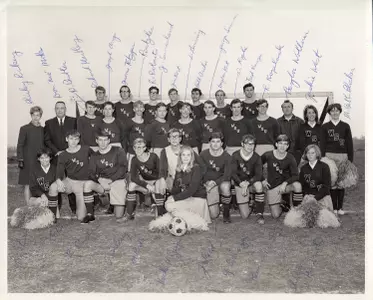
1968 Team Made Raider History
8/25/2016 4:00:00 AM | Men's Soccer
By Andrew Call
As the 2016 version of the Wright State men's soccer team opens the regular season this weekend, we took a moment to look back at where it all started.
Members of Wright State's first intercollegiate sports team didn't often contemplate their place in athletic history.
They were having too much fun at the time.
“Frankly, that part of it didn't faze us too much,” said James Sillery, a junior on the 1968 men's soccer team. “The most enjoyable part of that season had more to do with the chemistry of the players than a sense of anything historic. We just really enjoyed each other, and playing soccer.”
The roots of soccer at Wright State can be traced back one year earlier, when a junior student named Bill Archer was named to an ad hoc committee studying the possibility of intercollegiate athletics at the newly named university. Originally founded as a branch campus of The Ohio State University and Miami University, Wright State had become an independent institution in 1967.
 Archer asked the administration for permission to organize a club team. When that permission was granted, he went to work. Archer built the goals and convinced his high school to donate the netting. He helped mark off and cultivate a field near the entrance to campus. He rounded up prospective players from a student body of about 3,500.
“I was just sitting in the library when I looked out the back window and I saw guys playing soccer,” Sillery said. “I walked out there and talked to Bill Archer, who told me they were organizing a club team.”
That newly christened club team was full of excitement when it took the field for its first contest against Bowling Green—and lost, 10-1. Still, Archer pressed the administration for the team to be upgraded to full varsity status for the next season.
“It became my mission, (athletic director) Don Mohr's mission and (faculty advisor) Cliff McPeak's mission,” Archer said.
“If not for Bill Archer and his diligence and hard work, Wright State would not have had soccer,” said Michael Rado, a goalkeeper on the 1968 team. “He was driven.”
Although that first field had no bleachers, fans began to notice the team. Six female students volunteered as cheerleaders and wrote a letter published in the December 1967 issue of The Guardian congratulating the Green and Gold (as the team was referred to in its early days) on its success.
In the book Founding and Fulfillment: Wright State 1964-84, Wright State University, Dayton, Ohio, author Charles W. Ingler wrote that James H. Allan of the Delco Products division of General Motors spearheaded a fundraising drive to help fund the first soccer team. On March 28, 1968, the Board of Trustees approved the addition of soccer for the 1968-69 academic year.
A new, much nicer field was constructed. The team now had a bus and uniforms … sort of.
“Those first uniforms looked like something players in Europe had worn during the 1930s—ugly,” Rado said. “Luckily for me, I was the goalkeeper so I could just go out and buy something different.”
Archer had played high school soccer in western New York, but most high schools in the U.S. had not yet adopted soccer. Junior Dayton Kort and freshman James Kort had grown up in Germany, where their Air Force father was stationed. Sillery had played at the Dayton YMCA. Rado had been on a club team with other players of Hungarian descent. Other players had also been member of club teams, often organized around ethnicity—Polish, British, Italians, Germans, even Dutch Indonesians.
Archer was playing on a Hungarian team when he met Bela Wollner, 32, a cabinet maker and a gritty player who excelled at the sport despite an obvious limp. Wollner told others he had been shot in the leg by a Russian soldier while attempting to escape into Yugoslavia just after the Hungarian Revolution of 1956. Wollner immigrated to the U.S. and went to night school at Dayton's Patterson Co-Op, earning his high school diploma in 1964.
 Archer suggested to Wollner that he apply to coach at Wright State, and Mohr acted on Archer's recommendation by hiring Wollner. He was an easygoing man with a firm grasp of the European game that he would try to pass on to players who, in some cases, were more inclined toward a style of play that more closely resembled American football.
The first 13-game schedule included four games against junior varsity teams and one contest against a team from Wright-Patterson Air Force Base. The first official varsity game took place October 5, 1968, a 4-2 victory over Wilberforce. Wright State also beat Wilberforce in a rematch, beat Malone 3-2 and tied Cedarville and Wilmington.
“I thought we actually did really well for a first-year team,” Dayton Kort said. “We were very competitive.”
Wright State fared well that first year (8-3-2), but there were trying times along the way. Starting goalkeeper Kenny Arnots sustained a broken leg during practice early in the season, forcing Rado to move from forward into the nets.
Wright State was down to one goalkeeper, and protecting Rado became a priority.
“Michael went up to catch a shot and a player from the other team undercut him,” Sillery recalled. “He went cartwheeling onto the ground, and that started a fight. The officials cleared the field. As soon as the game started again, Dayton Kort came running across the field and cold-cocked some guy. As for me, I was 5-foot-8 and 110 pounds. I wasn't much of a fighter.”
Archer, the only senior on the roster, led the team with six goals. Kort added five and Sillery two.
The team was moved up from Division II to Division I by the Ohio Collegiate Soccer Association in 1969 and did not fare as well record-wise (2-7-2), but rebounded in 1970 (8-2-0). Jorge Simon, a member of the 1968 team, stayed through 1971 and become Wright State's first four-year letterwinner.
The foundation had been laid for today's athletic program. Wright State fields 15 NCAA Division I teams, including men's soccer.
The Raiders currently play at 1,000-seat Alumni Field, built in 1999 and renovated in 2011 as part of the Rinzler Student Sport Complex project. The facility includes synthetic turf, lighting for night games, and is utilized by many area teams and tournaments. Wright State's men's team, playing in the Horizon League, has forged records of 12-7-2 and 12-8-1 the last two seasons, playing its way into the league tournament championship game both years.
 Wright State's enrollment has grown to 18,000 and its campus has expanded from four buildings in 1968 to 71 buildings devoted to academics, academic support and infrastructure, 33 student residential buildings, and the 11,000-seat Nutter Center.
“I probably wouldn't recognize the place,” Kort admitted.
“I came to campus eight years ago, and it was a beautiful sight,” Archer said.
Archer, oddly enough, was the least involved in soccer after college. He earned a master's degree in sculpture, taught art, then spent 18 years as manager of bridges and facilities for a railroad line.
Kort played recreational soccer and was a driver/engineer for the Gwinnett County (Georgia) Fire Department for 31 years. Sillery coached youth and high school soccer while practicing law in Athens, Ohio, for 42 years. Rado became one of the state's most respected referees, officiating four NCAA finals and being inducted into the Ohio Soccer Hall of Fame in 2012.
“Soccer is a great sport and college athletics is very important,” Archer said. “It was exciting to help start the team at Wright State. It just seemed like the right thing to do.”